Atmospheric Rivers and Mold: How to Protect Your LA Home After the Rain
Southern California spends most of the year dry, and then a few winter storms deliver a large share of the annual rainfall all at once. These storms are often atmospheric rivers, long ribbons of moisture that stream in from the Pacific and park over the region for days. For Los Angeles property owners, the danger does not end when the sky clears. Mold after rain is one of the most common and overlooked problems LA property owners face.
What an Atmospheric River Does to a Dry City
Atmospheric rivers are a normal part of West Coast winters, but their intensity has been hard to ignore in recent years. Back to back storms in the winter of 2022 to 2023 pushed much of California to several times its average rainfall. In early February 2024, two atmospheric rivers drove downtown Los Angeles to roughly three quarters of its annual rainfall within days and triggered hundreds of landslides across the greater LA area. Another system in February 2025 raised serious debris flow concerns over slopes left bare by the January fires. The pattern is clear. Los Angeles can take months of rain in a single week.
A city built for dryness is not built for that. Local drainage and typical construction both assume a normal year, and they get overwhelmed when months of water arrive at once. A great deal of that water ends up somewhere it should not be.
Why the Real Risk Comes Later
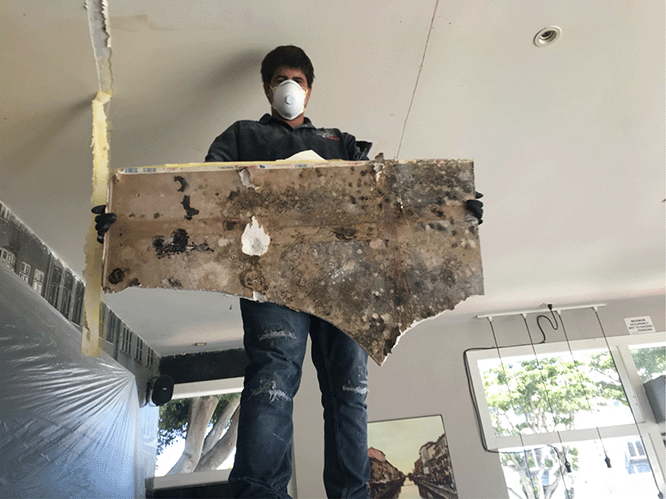
Mold needs only 24 to 48 hours of moisture to begin growing. After an atmospheric river, water finds its way into wall cavities, under flooring, into crawlspaces, and along attic framing, often with no visible sign on the surface. In our dry climate, that trapped moisture does not clear the way owners expect. Our founder has opened walls in the LA area a full six months after a storm and found the framing behind the drywall still wet. A sealed cavity with no airflow holds water long after the streets are dry.
This is how a storm in February becomes a health complaint in summer. The leak that seemed minor, the damp spot that looked dry, the crawlspace no one checked, the attic no one visits, any of them can be quietly growing mold while the home looks perfectly normal.
Hillside Homes Face Extra Pressure
Many of the most desirable properties around Los Angeles sit on hillsides and foothills, and they carry a moisture risk that flat lots do not. When a neighboring lot sits above yours, storm runoff and groundwater flow downhill below the surface and collect against your foundation. That hydrostatic pressure forces moisture into crawlspaces and slabs, and capillary action pulls it upward through concrete and wood. After a major atmospheric river, that pressure can keep a crawlspace damp for months. We see it throughout the hillside neighborhoods of Pasadena, Glendale, and the surrounding foothills.
What Owners Should Do After a Storm
The most important window is the first day or two. If you find water intrusion, get the area opened and professionally dried within 24 to 48 hours rather than waiting to see if it clears on its own. After a heavy storm it is worth checking the places water hides, which means looking at ceilings and walls for fresh stains, inspecting the crawlspace and attic, watching for musty odors that were not there before, and noting any room that suddenly feels damp. A faint ceiling stain that you might ignore because rain is rare is exactly the kind of clue worth taking seriously.
When you are not sure what the water left behind, a professional mold inspection with moisture metering will find what a visual check misses.
How Mold Zero Handles Mold After Rain in Los Angeles
We trace the moisture to its source, treat the whole affected environment rather than a single room, and verify the result with independent lab testing. On hillside properties we often address the water itself, installing a crawlspace vapor barrier and, on slopes with constant subsurface water, deep French drains that direct groundwater away from the foundation. Our work is NORMI certified and backed by a one-year guarantee. Storm related moisture rarely fixes itself, and our mold remediation process is built to correct the source so the problem does not return with the next season.
If you are dealing with mold after rain in Los Angeles, do not wait for symptoms to appear. Call Mold Zero or book your free inspection today. We serve Pasadena, San Marino, Glendale, Arcadia, and the greater Los Angeles area.