Commercial Mold Remediation for Los Angeles Property Managers, HOAs, and Building Owners
When a tenant reports mold in a unit you manage, the next 48 hours matter. Mold establishes a viable colony within 24 to 48 hours of a moisture event. By the time the complaint reaches your desk, the colony is already developed, spores have likely entered the building’s HVAC system, and the contamination has spread past the unit where it was first noticed. The call you make in the next hour decides whether this stays a contained remediation or becomes a building-wide project.
Mold Zero is a NORMI-certified commercial mold remediation company serving property managers, HOA boards, and commercial building owners throughout Los Angeles County. Every project is documented with independent third-party laboratory clearance, not in-house testing we control. Rusty Tweed, Mold Zero’s founder, built this company under Florida’s state mold licensing requirements, the strictest in the country, before bringing that standard to California, where no regulatory floor exists. Every commercial remediation we complete carries a 1-year guarantee.
If you manage property in the Los Angeles area and have a mold situation right now, call us at (626) 671-8885. If you are evaluating vendors for an ongoing portfolio program, read on.
Why Commercial Mold Remediation Is Fundamentally Different From Residential
A homeowner with a mold problem is managing one environment and one set of health concerns. A property manager or building owner is managing liability, tenant relationships, lease agreements, insurance claims, regulatory exposure, and asset value at the same time. The remediation process itself may be similar, but everything around it is different, and a vendor who does not understand that context will create as many problems as they solve. Mold Zero learned that standard the hard way in Florida, where state rules required an independent assessor to test every insurance remediation, and a failed test meant redoing the entire job. That pressure is why the company treats documentation and third-party verification as part of the work rather than an upsell.
In a multi-unit building or commercial space, mold in one area is rarely contained to that area. Commercial HVAC systems are built to circulate air across entire floors. Mold spores range from 2 to 20 microns, small enough that the smallest species behave almost like smoke, staying airborne for long periods and traveling wherever conditioned air flows. A colony in a ground-floor storage room or a basement mechanical space is already seeding every occupied floor connected to the same air handling system. Remediating the source unit without addressing the HVAC system does not solve the problem. It restarts it.
Commercial remediation also demands documentation that residential work rarely requires. Tenant disputes, habitability claims, insurance carriers, and attorneys all need written evidence of what was found, what was done, what the lab showed before treatment, and what the independent verification confirmed afterward. A company that does not routinely produce this documentation is not equipped to serve commercial clients.
The Situations That Mean You Need to Call Today
Commercial clients do not search for mold remediation out of curiosity. They search because something specific has happened. These are the trigger events that warrant an immediate professional response.
A tenant has submitted a formal mold complaint. Whether written or verbal, a documented complaint starts a clock. Habitability obligations under California law are not optional, and the speed and professionalism of your response will matter in any subsequent dispute.
Your building has had a water damage event. Pipe failure, roof leak, HVAC condensate overflow, or appliance malfunction that was not dried professionally within 48 hours should be treated as a potential mold event. Mold begins below the surface, inside wall cavities and under flooring, where standard drying equipment does not reach.
There is a musty odor in a common area or a mechanical room. Odor in shared space means spores have been circulating in shared air, and the source is somewhere in the building envelope or the HVAC system rather than necessarily where the smell is strongest.
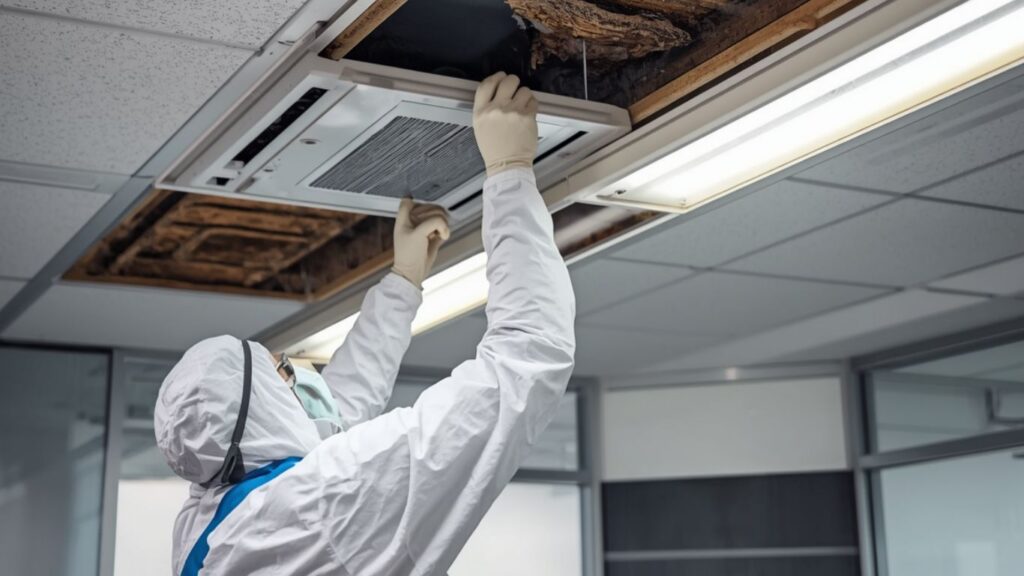
An inspector has flagged your HVAC system. Evaporator coils, condensate drain pans, and return air cavities are the most common sites of mold amplification in commercial buildings. A flagged system usually means the building has been distributing contaminated air for a long time.
A lease renewal or a property sale requires environmental due diligence. Pre-transaction inspection and clearance documentation protects both parties and removes the most common source of post-closing disputes in California commercial real estate.
Commercial Property Types Mold Zero Serves
Mold Zero has worked across the full range of commercial and income-producing properties in the Los Angeles market. Each type carries its own risk profile and documentation needs.
Apartment buildings and multi-unit residential complexes carry the broadest liability exposure. A single affected unit in a building with shared HVAC, shared walls, and shared crawlspace is rarely a single-unit problem. We inspect the source, the connected envelope, and the air handling system before scoping the work, because treating one unit while leaving the distribution pathways active produces a recurring complaint.
HOA and condo associations face a specific challenge, because the boundary between unit-owner responsibility and association responsibility is rarely clear when mold crosses a shared wall or an association-maintained HVAC system into a unit. Mold Zero provides documented inspection findings that identify source locations, affected areas, and moisture pathways, which is the information a board needs to make defensible decisions about scope and cost allocation.
Office buildings and retail spaces often have mold in areas tenants never access, such as above drop ceilings, in mechanical rooms, and in sub-level storage. By the time complaints emerge, the source has usually been active for months. We work quickly and with minimum disruption to occupied space, and we provide documentation suitable for lease compliance and insurance claims.
Medical offices, dental practices, and other professional environments have occupants who may be immunocompromised or particularly sensitive to air quality. These spaces require the highest standard of clearance verification and the most complete documentation. Our NORMI certification and independent-lab protocol make Mold Zero the right choice when air quality is a matter of care rather than comfort.
For Property Management Companies: The Portfolio Vendor Relationship
Most mold remediation companies treat every job as a one-time transaction. The manager calls, the work gets done, and the relationship ends. Mold Zero operates differently for property management companies, because the problem they face is not a one-time event. It is an ongoing operational risk across a portfolio.
Property management companies that work with Mold Zero as a portfolio vendor get consistent response times, consistent documentation that slots into your existing workflow, and a team that understands tenant timelines, insurance carrier requirements, and the cost of a remediation that has to be redone because the source was not correctly identified the first time.
We offer recurring inspection programs for portfolios. That means scheduled assessments of high-risk properties before problems become complaints, along with documentation packages built for tenant communications, lease renewals, and owner reporting. If you manage more than a handful of properties in the LA area, including communities that require HOA mold remediation, a standing relationship with a certified, documented, lab-verified remediator is a liability decision as much as an operational one. Contact us to discuss portfolio programs and preferred-vendor agreements.
What Commercial Mold Remediation Actually Involves
The most important thing to understand is that remediation must begin before any disturbing of visible mold, not after. When a colony is disturbed without proper protocol, it releases spores defensively into the air, and in a building with active HVAC circulation those spores travel immediately to every connected space. Any vendor who starts by scrubbing visible mold before neutralizing it is making the problem worse.
Mold Zero’s 5-step process was developed across thousands of projects in California and Florida, including under Florida’s mandatory independent-verification requirements. It is designed to eliminate mold at every stage rather than addressing any single one in isolation.
The process begins with comprehensive HEPA vacuuming of all surfaces, using equipment that captures particles down to 0.3 microns, which removes loose spores and the organic debris mold feeds on before any chemical treatment. Air scrubbers run continuously throughout the project. Manual surface cleaning follows, with every reachable surface wiped using a non-toxic antimicrobial that removes residue and eliminates the nutrition mold needs to re-establish. This step is the one most often skipped by companies that rely entirely on fogging, and it is why those remediations frequently need to be redone.
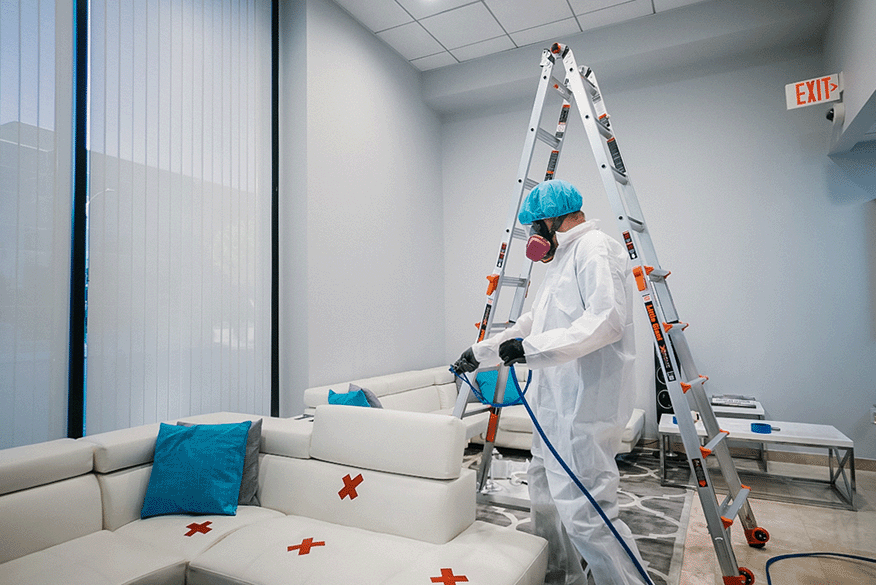
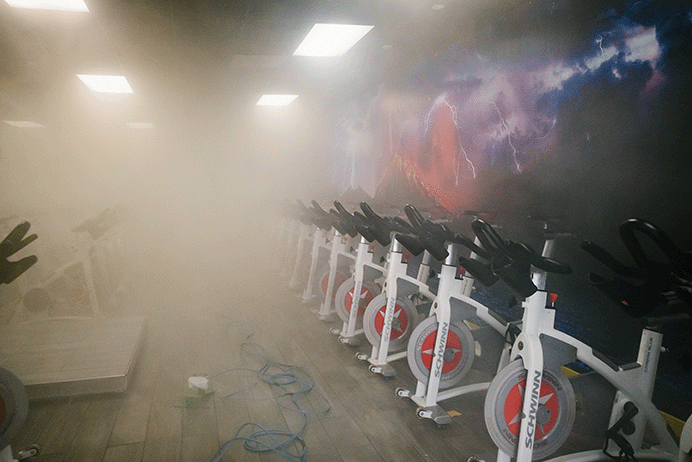
Whole-area fogging with SPOR-KLENZ then reaches cracks, wall voids, and airspace that physical cleaning cannot access, denaturing mold at a molecular level so it can no longer reproduce. A second detailed wipe-down removes the dead mold and mycotoxins. A final protective fog with GoldShield bonds to treated surfaces and creates a durable barrier against future colonization, which is what supports the 1-year guarantee.
In any commercial building, the HVAC system receives mandatory treatment as part of the scope. Air handlers, coils, drain pans, ductwork, and return cavities are cleaned by a specialist and then fogged with sterilant drawn through the entire system. Standard filters rated MERV 6 to 8 do not reliably capture spores in the 2 to 5 micron range, so we specify MERV 16 filtration with carbon on every commercial remediation. Post-remediation verification is mandatory. An independent laboratory tests the same locations sampled before work began, and a successful result shows indoor levels at or below outdoor background with no marker species present. That report, together with our written scope and inspection findings, is the documentation package we hand to managers, carriers, and attorneys.
Los Angeles Commercial Mold Risks: What Makes This Market Different
Los Angeles is not a high-humidity market the way the Gulf Coast is. That perception has caused more building owners to ignore mold risk here than almost anything else. The real moisture profile of LA commercial real estate is more complicated, and in some ways more treacherous, than a consistently humid climate.
Older building stock throughout the city presents vulnerabilities that newer construction does not. Buildings from before modern vapor-barrier standards use concrete, plaster, and framing that absorb and hold water far longer than contemporary materials. We have opened walls in LA commercial buildings six months after a reported leak and found the interior still wet. In a sealed building with limited internal air circulation, water intrusion does not self-resolve.
Coastal properties on the Westside and in the South Bay, from Santa Monica and Culver City to El Segundo, Torrance, and Long Beach, sit in ambient humidity that hovers near mold’s growth threshold year-round. For buildings with aging HVAC, north-facing walls with little sun, or below-grade mechanical spaces, that baseline is enough to sustain active growth without any visible water event.
Hillside and foothill properties in the Hollywood Hills, Silver Lake, Los Feliz, Echo Park, and the San Gabriel foothills face hydrostatic pressure. When the property uphill runs irrigation, fills a pool, or simply sits on rain-saturated soil, that water migrates downhill under pressure and pools against the foundations of lower buildings. Concrete is porous, so that pressure forces moisture through foundation walls into crawlspaces and basement-level spaces continuously, independent of rainfall. The buildings most often surprised by this are the ones told they sit in a desert climate and built without drainage designed for year-round groundwater.
Large commercial HVAC systems present a distribution risk with no residential equivalent. A central air handler serving multiple floors means a colony in one mechanical room or one uncleaned condensate pan is actively seeding every occupied space on every connected zone. Mold Zero treats the HVAC system as a mandatory component of any commercial remediation, never an optional add-on.
Schedule a Commercial Mold Inspection or Discuss a Portfolio Program
If you manage or own commercial property in the LA area and have a mold situation that needs professional attention, the right move is an immediate call. Mold Zero schedules commercial inspections quickly, responds to urgent situations with priority scheduling, and provides every client with the independent lab documentation that commercial property management requires. If you are evaluating vendors for a portfolio relationship, contact us about recurring inspection programs and documentation packages built for property management operations. What is not corrected at the source always comes back, and we make sure it does not. Call (626) 671-8885.