
When mold turns up in a community you help govern, the questions land on the board fast. Is this the association’s problem or the unit owner’s? Who pays for it? What is the board’s exposure if a resident gets sick? HOA mold remediation sits in a gray zone that most boards are not prepared for, because mold rarely respects the line between a private unit and common property. Getting the response right protects the association’s budget, its residents, and the board members personally.
Mold Zero handles HOA and condo mold work across the Los Angeles area. The company is led by Rusty Tweed, who is NORMI-certified and BBB-accredited, with more than a thousand remediation jobs behind him across California and Florida. That experience matters here, because community mold problems are rarely as contained as they first appear.
Where the Association's Responsibility Usually Begins
Most governing documents draw a line at the drywall. The unit owner handles what is inside their walls, and the association handles the structure, the common areas, and the shared systems. Mold complicates that line, because the moisture driving it often originates on the association’s side even when the visible growth appears inside a unit. A roof leak, a slab issue, a shared plumbing stack, or a common-area drainage failure can all seed mold that surfaces in a resident’s bedroom. When the source is association property, the remediation usually is too. This is why identifying the true source, rather than just the visible patch, is the single most important step in HOA mold remediation.
The Shared Systems That Spread Mold Across a Building
Condo and multi-unit buildings often share HVAC infrastructure, and that changes how mold moves through the community. Spores measure between 2 and 20 microns, small enough that the smallest of them travel like smoke and get pulled into return vents. Once they are inside a shared system, they are distributed to every unit that system serves. A colony that started in one ground-floor unit can seed spores in units three floors up. Treating one unit while the shared system stays contaminated is how a community ends up with a second complaint a month after the first was closed.
Garages, Crawlspaces, and the Groundwater Problem Boards Miss
A lot of community mold quietly begins in the common areas. Subterranean garages, crawlspaces, and ground-floor storage sit closest to the soil, and in much of Los Angeles that soil holds more water than people expect. Communities built on the hillsides and foothills, from the areas around Glendale and Pasadena to the Hollywood Hills, deal with hydrostatic pressure. Water from higher ground moves downhill through the soil, reaches the foundation of the lower building, and pushes moisture through porous concrete into garages and crawlspaces year round. Capillary action then pulls that moisture up through walls and framing. Rusty found his own worst example in a crawlspace he did not know his house had, where a leaking HVAC drain had quietly grown a three-foot patch of mold completely out of sight. The same thing hides under the shared structures of a condo community, and it is usually discovered only when someone finally goes looking. This is exactly the kind of shared-structure moisture that makes HOA mold remediation a whole-building job rather than a single-unit repair.
Board Liability and Why Documentation Protects You
For a board, mold is not only a repair issue. It is a liability issue. Residents can raise habitability claims, insurers ask hard questions, and directors worry about personal exposure. The protection is documentation. Mold Zero sends samples to an independent third-party laboratory rather than testing its own work, and every project produces a written record of what was found, what was done, and what the post-remediation verification confirmed. The EPA’s guidance on mold in schools and commercial buildings, which covers multi-occupant properties, treats that kind of documentation and resident communication as essential rather than optional. That record is what the board relies on with insurers, with residents, and with legal counsel if a dispute develops. A vendor who offers a verbal all-clear and no paperwork has left the board exposed.
What Professional HOA Mold Remediation Involves
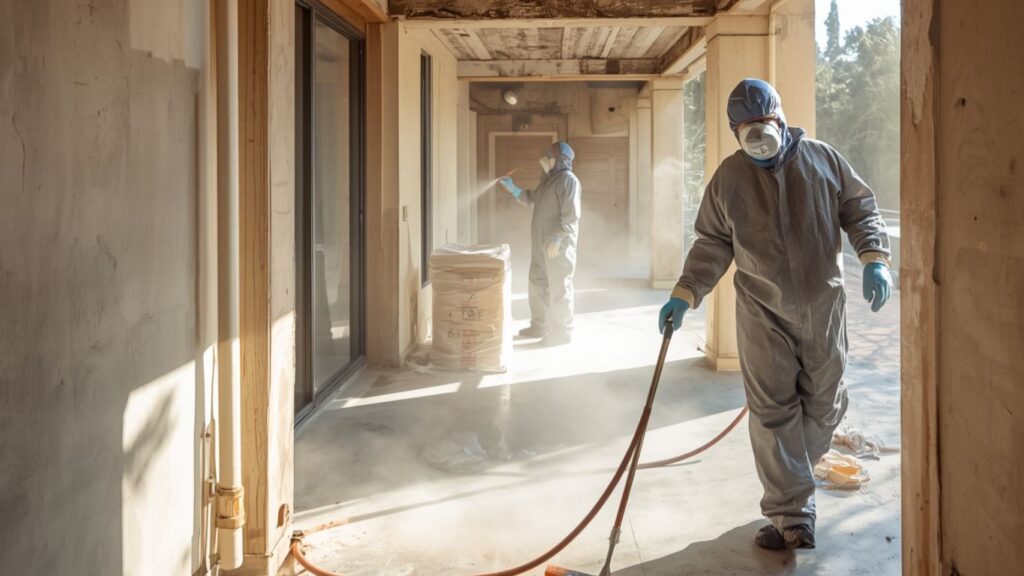
Sound HOA mold remediation begins before anyone touches the visible mold, because disturbing a colony without containment releases spores into shared air. The first step is always finding and correcting the moisture source. From there the remediation process works in stages. Technicians HEPA-vacuum the surfaces, hand-wipe them with a non-toxic antimicrobial, fog the space to reach the voids and air that cleaning cannot, wipe down a second time to remove dead material, and lay down a protective final treatment. In a shared building the HVAC system is treated as part of the scope, never skipped to save time. The whole point is to treat the community as the connected environment it actually is, rather than chasing mold one unit at a time.
Schedule an Inspection for Your Community
If your board has had a mold complaint, or you oversee common areas and shared systems with a history of water problems, the responsible first step is a professional inspection. It is far less expensive than discovering the full scope during a resident dispute or an insurance claim. Mold Zero also provides commercial and multi-unit mold remediation for larger properties, and every community engagement carries our independent-lab verification and 1-year guarantee. Handled properly, HOA mold remediation restores the community and protects the board that acted on it. Call Mold Zero at (626) 671-8885 to schedule a free inspection, or book online through our mold inspection page.