
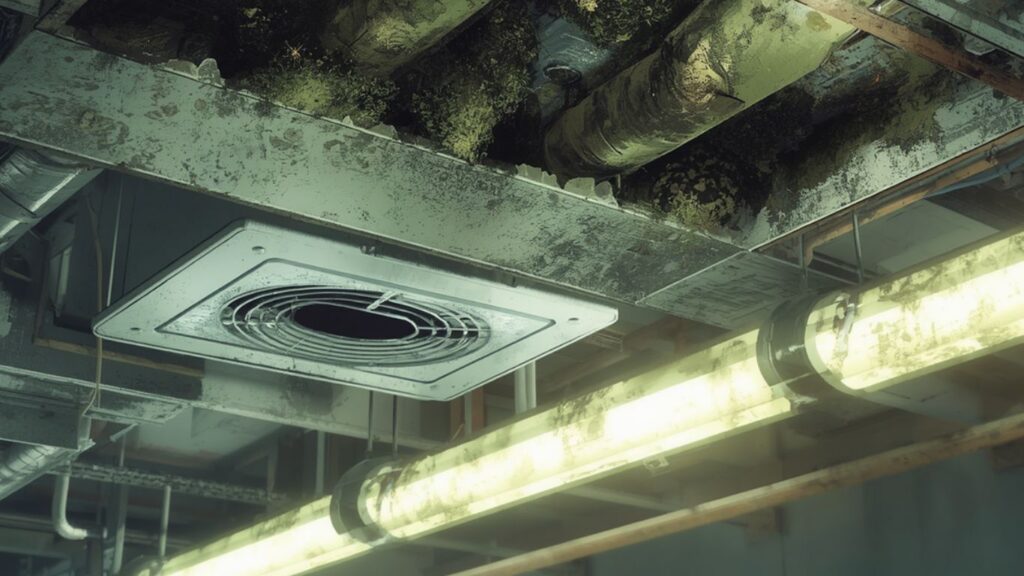
Mold in commercial HVAC systems is one of the most underestimated risks in building management. A colony in a single air handler or one neglected condensate pan does not stay put. The HVAC system is designed to move air through the entire building, and in doing so it moves mold spores to every space it serves. Understanding how mold in commercial HVAC systems spreads is the key to understanding why a whole-building response is the only response that actually works.
Mold Zero has treated HVAC-driven mold in office buildings, medical suites, retail spaces, and multi-unit residential properties across Los Angeles. This guide draws on that field experience and the methodology in Rusty Tweed’s book on mold.
How Mold in Commercial HVAC Systems Travels So Far
Mold spores are tiny. Most measure between 2 and 20 microns, and the smallest species behave almost like smoke. For comparison, a human hair is roughly 70 to 100 microns across, so the smallest spores are a small fraction of that width. Particles that size stay airborne for long periods and get pulled easily into return vents. Once they are in the ductwork, the system distributes them wherever it sends air. This is the mechanical reason mold rarely stays in the room where it started.
Where Mold Grows Inside an HVAC System
The system creates its own moisture. Evaporator coils condense water, drain pans collect it, and any blockage or slope problem leaves standing water behind. Add the dust and organic debris that settle on coils and inside ducts, and the system offers mold everything it needs to colonize. Common growth sites include evaporator coils, condensate drain pans, insulated plenums, flexible duct liner, and the return air cavities themselves. In our experience the drain pan and the coil are the two spots that start the problem most often, because they hold water every time the system runs through a cooling cycle. Rusty saw the extreme version of this in Florida, when a client left town for a week and the building’s air conditioning failed. Heat and humidity took over the closed space, and he returned to find what looked like peach fuzz growing across the walls and furniture, enough that the ruined pieces had to be hauled out. A commercial system that quits over a long holiday weekend can do the same thing on a far larger scale.
The Filtration Most Buildings Rely On Does Not Stop Spores
Here is the part that surprises building owners. A standard filter rated MERV 6 to 8 does not reliably capture particles in the 2 to 5 micron range, which is exactly where many mold spores fall. The air feels filtered, but the spores pass through and recirculate. High-efficiency filtration rated MERV 13 to 16 captures a far higher percentage, and true HEPA filtration captures 99.97 percent of particles down to 0.3 microns. Mold Zero specifies MERV 16 filtration with carbon on commercial systems for this reason.
Warning Signs the HVAC System Is the Source
A few patterns point back to the HVAC system. Odors that are strongest near vents, occupant symptoms that worsen when the system runs, mold that keeps returning after cleanup, and visible debris or condensation on registers all suggest the system is involved. When mold comes back weeks after a surface cleaning, the air handling system is very often the reason it returned.
Treating the visible mold in one office or one unit while leaving the HVAC system untouched is the most common reason commercial remediations fail. The spores pulled into the system before the cleaning are still there, waiting for the next cycle to redistribute them. Mold in commercial HVAC systems has to be addressed as part of the remediation, not skipped to save a day of labor.
How Mold Zero Treats a Contaminated System
Treating mold in commercial HVAC systems takes more than a filter change. The metal components are cleaned directly, and porous or internally contaminated duct materials are replaced when cleaning cannot reach the growth. A specialist mechanically cleans the ductwork, and the system is then fogged with sterilant drawn in through the return so the treatment circulates through the entire network. For buildings with a history of moisture, an energized hydrogen peroxide system can be installed to keep circulating a mild continuous treatment that suppresses regrowth between service visits. The goal is a system that stops acting as a distribution network for the next colony.
Protect the Whole Building
If mold has been found anywhere in a commercial building, the HVAC system deserves the same scrutiny as the walls and floors. Mold in commercial HVAC systems is not a maintenance afterthought. A thorough commercial mold inspection will check the system, and a complete remediation will treat it. Ignoring it is how a contained problem becomes a building-wide one. Mold Zero handles both the inspection and the commercial mold remediation in Los Angeles, with independent lab verification confirming the result.
Talk to Mold Zero
If you manage a commercial property in the Los Angeles area and suspect your HVAC system is spreading mold, call Mold Zero at (626) 671-8885 for a free inspection, or book online. Catching it in the system is far cheaper than chasing it through every room it has already reached.