
When a tenant reports mold in a unit you manage, the clock starts that same day. Mold remediation for property managers is a different job than it is for a homeowner dealing with one bathroom. You are balancing habitability obligations against owner expectations, and the problem has usually already moved past the unit where it was first reported. What you do in the first few days decides whether this stays a contained repair or grows into a building-wide expense.
Mold Zero handles this work for property managers and owners across the Los Angeles area. The company is led by Rusty Tweed. He is NORMI-certified and BBB-accredited, and he has completed more than a thousand remediation jobs across California and Florida. That field experience is the foundation for everything below.
A Tenant Mold Report Is a Clock, Not a Ticket
Mold can establish a colony within 24 to 48 hours of a moisture event. By the time a tenant notices a musty smell or a dark patch and reports it, the growth is usually well established. The visible mold is only the part that has broken through the surface. The colony inside the wall cavity or under the flooring has been developing far longer.
Treating that report as a routine work order, to be scheduled whenever a vendor has an opening, lets the problem widen while you wait. California habitability law does not run on your vendor’s calendar. Your response is also the paper trail you will depend on if the tenant later disputes how the matter was handled. Handling it quickly and documenting it properly protects the owner and protects you.
Mold Rarely Stays in the Unit Where It Started
This is the detail most owners miss, and it is the one that turns a small job into a large one. Mold spreads through the air, and in a multi-unit building the air is connected. Mold spores measure between 2 and 20 microns. The smallest of them behave almost like smoke, staying airborne for long stretches and drifting wherever air currents take them.
Your HVAC system is built to move air through the building, which means it also moves spores. Once spores reach a return vent, the system carries them to every space it serves. A colony in one ground-floor unit does not respect the walls between units. In his book, Rusty makes the point directly. If mold is in one room, the spores have already been released, pulled into the air handling system, and scattered across the property, waiting for moisture and a food source to bloom into new colonies.
That is why a single-unit approach fails on a managed property. You can clean the reported unit perfectly and still have spores seeded through the shared system, ready to grow the next time a pipe sweats or a roof leaks. Effective mold remediation for property managers has to account for the shared air, not just the affected unit.
Why the Cheap Fix Costs You More
The most expensive mistake in mold remediation for property managers is the cheap fix that looks clean for a month. When a maintenance crew wipes visible mold with bleach and calls it finished, the wall looks fine for a few weeks. Bleach does not penetrate porous materials like drywall or wood. Disturbing a colony without containment also triggers it to release spores defensively into the air. Those spores then ride the HVAC system to new locations and wait.
Rusty describes a Los Angeles case that shows how hidden this can get. A client had bought a home in the Hollywood Hills and could not sleep well from the day she moved in. Every visible surface looked clean. Under the carpets, the padding had never dried properly after a prior cleaning, and mold had spread across a wide area completely out of sight. After a proper remediation, she called a few days later thrilled that she was finally sleeping through the night.
On a property you manage, that same hidden growth under flooring or behind a wall is exactly what a surface wipe will never reach. It is also what a tenant’s health complaint or a pre-sale inspection will eventually surface, usually at a worse moment and a higher cost.
What Real Mold Remediation for Property Managers Looks Like
Real remediation starts before anyone touches the visible mold. The first job is finding and correcting the moisture source, because mold cannot grow without water. Skip that step, and the mold returns no matter how well the surface was cleaned.
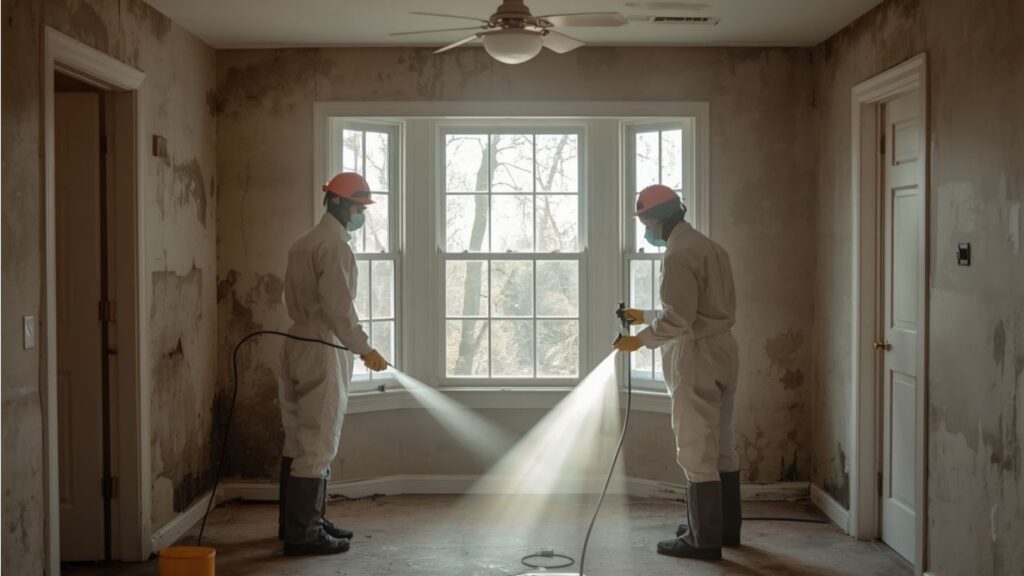
From there, the Mold Zero process works in stages. Technicians HEPA-vacuum all surfaces to capture loose spores and the dust that feeds them. Every reachable surface is then hand-wiped with a non-toxic antimicrobial to remove residue and nutrition. The space is fogged so the treatment reaches the cracks and wall voids that physical cleaning cannot touch, and it denatures spores still hanging in the air. A second detailed wipe-down removes the dead material and mycotoxins. A final protective fog lays down a barrier that resists future growth.
On any multi-unit or commercial property, the HVAC system is treated as part of the job rather than an afterthought. Standard filters rated MERV 6 to 8 do not reliably capture spores in the 2 to 5 micron range. Mold Zero cleans the system and specifies MERV 16 filtration so the equipment stops acting as a distribution network for the next colony. You can see the full process on our mold remediation page.
Documentation Is Part of the Deliverable
For a homeowner, remediation ends when the house is clean. For a property manager, it ends when you have the paperwork to prove it. Mold Zero sends air and surface samples to an independent third-party laboratory rather than testing its own work. The pre-remediation results establish what was present. The post-remediation verification confirms that indoor levels have dropped to or below normal outdoor levels with no marker mold species left behind.
That written record is what you hand to an owner or submit to an insurance carrier. It is also what you rely on if a tenant claim moves toward a dispute. The EPA’s guidance for mold remediation in schools and commercial buildings treats communication and documentation as core to a defensible cleanup, not optional extras. A vendor who cannot produce that record is not equipped for managed property. This is the difference between real mold remediation for property managers and a quick surface wipe that photographs well.
Get Ahead of the Next Complaint
The property managers who spend the least on mold over time are the ones who stop reacting to it. A recurring inspection program catches moisture intrusion before it becomes a tenant complaint, and it gives you documented conditions for lease renewals and owner reporting. A single professional mold inspection on an at-risk building often costs a fraction of a full remediation, and it buys you time to plan rather than scramble.
If you manage residential or commercial property across the Los Angeles area, Mold Zero can serve as the vendor you call for the whole portfolio. Mold Zero also provides commercial mold remediation services for office buildings and larger commercial facilities, and it handles HOA common areas with the same certified, documented approach used on a single unit.
Book a Free Inspection
If a tenant has reported mold, or you suspect a moisture problem on a property you manage, the right move is a professional assessment now rather than a bigger project later. Call Mold Zero at (626) 671-8885 to schedule a free inspection, or book online. You will get an honest evaluation, clear documentation, and a team that treats your liability as seriously as you do. Sound mold remediation for property managers begins with one phone call.