
Mold Removal/Glendale, CA
One unit’s leak
is the building’s problem.
From 1920s Spanish houses to shared-wall condominium stock, and the two need completely different scopes. Say which you have.
A free inspection for a Glendale home or building
Glendale runs from 1920s Spanish houses to large HOA-governed condominium stock, and the two need completely different scopes. Say which you have and the visit is arranged accordingly.
Why Glendale houses grow mold
Glendale carries two housing markets in one city. There is the older single-family stock, 1920s Spanish and Mediterranean on raised foundations with the usual pre-war strengths and weaknesses. And there is a very large body of condominium and HOA-governed multifamily, much of it on slab, with shared walls, shared plumbing stacks and shared responsibility for what happens inside them.
In the multifamily half, the defining fact is that water does not respect unit boundaries. A supply line failure in a bathroom on the third floor arrives in a wall cavity on the second, and the resident who reports the smell is frequently not the resident whose plumbing caused it. By the time the board hears about it there are usually two or three units involved and a question about who is responsible for which part of the wall.
That changes what a remediation scope has to do. It is no longer enough to treat a room; the work has to establish which areas are affected, document each one, and produce a clearance a board and an insurer will both accept. A same-day turnaround matters commercially here too, because a scope that opens up occupied multifamily means displaced residents and a conversation nobody wants to have at a board meeting.
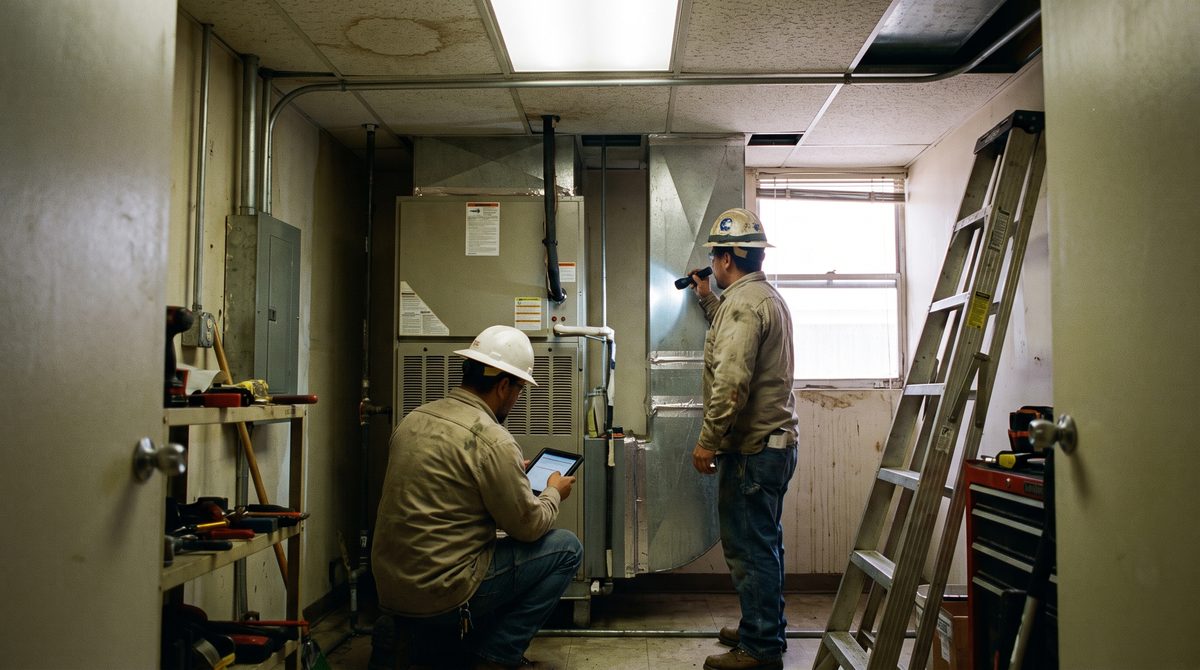
What an inspection checks first in Glendale
First stops in a Glendale building
- The plumbing stack serving the reporting unit, and the units above and below it
- Shared wall cavities either side of the reported area, metered from both sides where access allows
- Common corridors and any shared HVAC or ducted system connecting the affected units
- Roof and parapet details where the top floor is involved
- For single family: crawlspace, attic and the usual pre-war retrofits
What a board actually needs
A scope per building, not per complaint. Documentation per treated area. Independent laboratory clearance that names the areas it covers.
One reviewer describes Eddie recording a walkthrough video so the findings could be presented accurately to a board of directors, which is the format a committee can actually act on.
Neighborhoods this comes up in most: Adams Hill, Rossmoyne, Verdugo Woodlands. The method does not change by address; what the inspector expects to find does.
The unit that smells it is rarely the unit that caused it.
This is the single most useful thing to know before a board spends money in shared-wall stock. Water travels along framing and down stacks, and the first person to notice is downstream of the fault rather than on top of it. A scope built around the complaining unit alone frequently treats the symptom in one apartment and leaves the source running in another.
Mold removal questions Glendale owners ask
That depends on the governing documents and on where the water originated, which is exactly why documentation matters more here than anywhere else. Our part is establishing what is affected and where the moisture came from, in writing; the responsibility question is settled with that evidence rather than without it.
Usually not. Areas are treated one at a time under containment while unoccupied, then released, and most are back in use the same day. That is a large part of why this method suits occupied multifamily better than a demolition scope does.
Yes, and it is a normal request. A written scope per area is the baseline, and a recorded walkthrough explaining what was found has been done before for exactly this reason: a board member who was not on site cannot act confidently on a summary somebody else paraphrased.
The single-family half of Glendale looks more like Eagle Rock or Highland Park: raised foundation, unconditioned attic, and the usual retrofit failures. Say so when you book and the inspection is arranged for that rather than for a building.
Book a free inspection in Glendale
Tell us whether this is a house, a unit, or a building somebody manages. The scope differs from the first visit.
What happens next
An inspector walks the property, most often Noel or Eddie, the two their customers name in review after review.
Written findings with the moisture source named, and no obligation attached to them.