
Storm Damage Mold Removal/Los Angeles County
The leak is the easy part.
The cavity is not.
Water that reached a wall cavity, an attic or a crawlspace does not dry on the schedule the room does. If rain got in, the first 48 hours decide whether this stays a drying job or becomes a mold job.
Water came in. Book the inspection first
Somebody maps how far the water actually traveled, which is never only the room you saw it in, and tells you whether you have a drying problem, a mold problem, or nothing at all.
Water got in. What to do in the first 24 hours
Photograph everything before you move it, and tell your insurer. Stop or isolate the source only if that is safe to do. Get standing water out and start drying as soon as it is electrically and structurally safe.
Then look past the stain. Check the rooms either side, the closets on exterior walls, the flooring edges, the attic above and the crawlspace below. What you can see is usually the edge of the wet area rather than the middle of it, and the parts that matter are the ones that do not dry on the same schedule as the room.
If the water was sewage or groundwater, if it reached a cavity you cannot verify is dry, or if the HVAC system may be wet, stop and call somebody. That is not upselling, it is the short list of situations a household fan cannot close out.
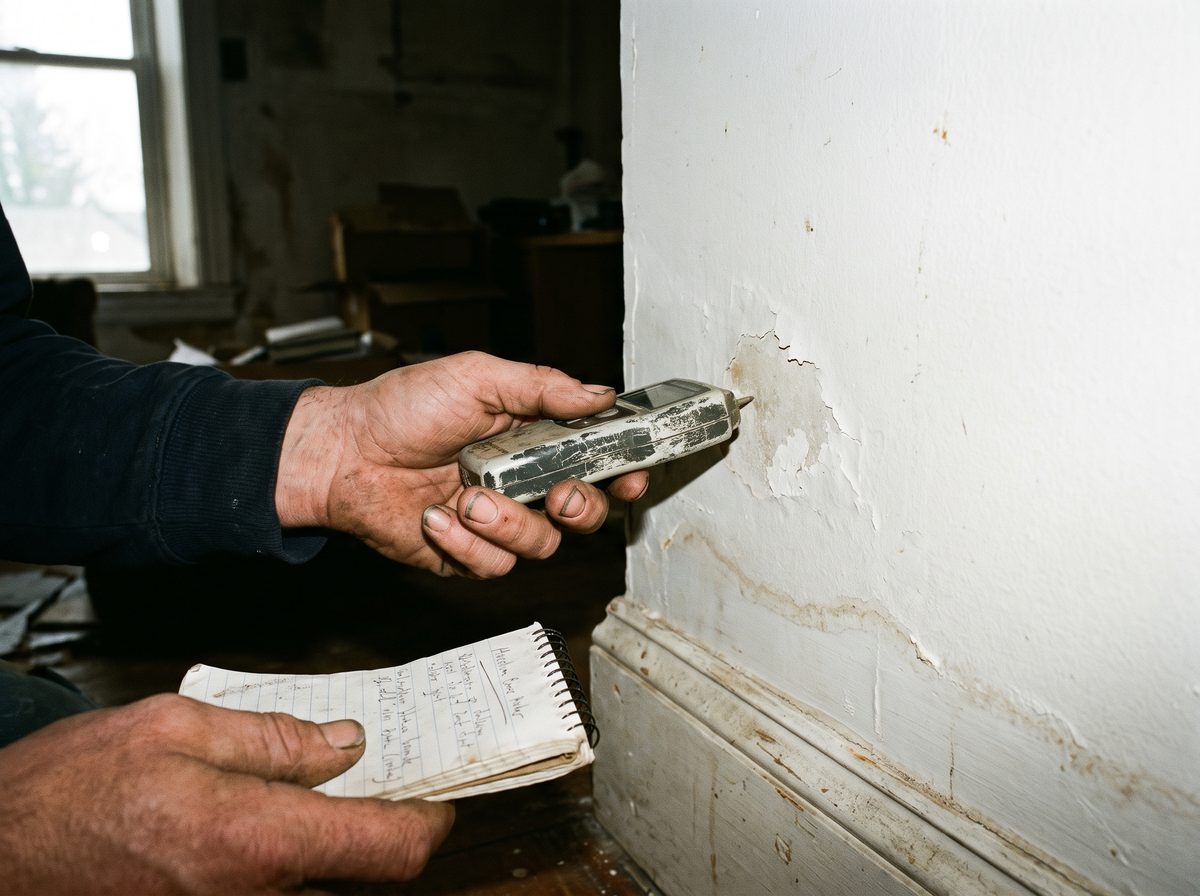
What the stain is usually the edge of
What you can see
- A small ceiling stain
- A damp baseboard
- A wet carpet edge
- A musty smell that arrives after rain
- Bubbling paint under a window
Where it usually leads
- Wet insulation, roof deck, a joist bay or a recessed light opening
- Drywall paper, the sill plate, the wall cavity or the flooring edge
- The pad, the tack strip, the subfloor and the lower drywall
- A closet on an exterior wall, the crawlspace, a cabinet void or an HVAC pathway
- The framing pocket, insulation, or the stucco interface below
24 to 48 hours.
EPA guidance is that wet or damp materials should generally be dried within 24 to 48 hours. That is not a clock that turns a building safe at hour 49; it is that delay is what lets hidden cavities, porous materials and dust become somewhere for growth to start.
So the useful question after a storm is not whether the room looks dry. It is whether anyone has checked the places that do not dry on the same schedule.
The rain stops. The moisture does not.
A storm ends on the forecast and the house carries on drying, or failing to, for weeks. If growth has already taken hold, the path is the signature five step fogging process: the water corrected first, the whole volume treated under containment, then cleared by an independent laboratory. You hear which situation you have at the inspection, in writing, before any work is proposed.
Why this winter is worth preparing for
NOAA’s Climate Prediction Center reported on 10 September 2026 that El Niño has strengthened further, and put the chance of a very strong event during the fall and winter of 2026 to 2027 at greater than 90 percent, with a 75 percent chance of a historically significant event between October and December.
That is a statement about the Pacific, not about your street. El Niño raises the odds of a wetter Southern California winter. It does not tell anyone where the rain falls, when, or how much, and any company telling you it guarantees a flood at your address is selling something.
What it does justify is doing the cheap work early, because the cheap work is only cheap before the rain. Los Angeles takes most of its water in a handful of events, and a flashing detail that weeps quietly all year can put enough into a cavity during one December storm to colonize it in days.
Before the next storm
- Have a roofer look at flashing, penetrations, skylights, chimneys and roof-to-wall transitions
- Clear gutters, downspouts, area drains and driveway drains, and confirm they still reach a legal discharge point
- Send downspouts away from the foundation, without pushing water onto a neighbor’s property
- Check grading, low spots, planters, retaining-wall drains and hillside runoff paths
- Test the sump pump by adding water to the pit, and check the alarm and backup power
- Walk the attic and the crawlspace with a flashlight, looking for staining, odor or existing damp
- Confirm the bath, kitchen and dryer exhausts terminate outdoors, not into the attic
- Photograph the property, and write down who you would call at 2am
Repair a known leak rather than coating over it, and never work on a wet roof.
Storm damage and mold questions we get every winter
It depends almost entirely on how fast the wet material dried and whether anything is still feeding it. Water that is found and dried inside the first day or two usually does not become a mold job. Water that sat in a cavity, under a floor or in insulation very often does, because those places dry slowly and nobody is looking at them.
No, and a good share of the inspections we run after a storm end with no mold work at all: a blocked drain, a fan venting into an attic, a slab leak that needs a plumber before it needs anyone else. What turns water into a mold problem is moisture that gets missed, trapped or left. That is why the first visit is about measuring, not selling.
It follows the cause rather than the mold. Growth after a sudden covered event, a burst line, a storm, is often covered; slow seepage usually is not, and many policies cap mold work under a rider. Standard homeowner policies generally do not cover flooding at all, and flood policies commonly carry a waiting period, so that is a conversation to have with a licensed insurance professional before a storm rather than during one. What we control is the file your adjuster sees.
When visible growth covers more than roughly ten square feet or shows up in several rooms; when water got into a cavity you cannot verify is dry; when the water was sewage or groundwater; when the HVAC system may be wet; when a musty smell outlasts the surface drying; or when somebody in the house has asthma, severe allergies or a compromised immune system. If the timeline is simply unknown, treat that as a reason to look.
No, and anybody who says yes is skipping the part that decides whether it comes back. The fog treats what is growing. It does not treat the reason it grew. The water has to be found and corrected, saturated material has to come out where it is beyond treating, and the result has to be verified by somebody independent. What is not corrected at the source always comes back.
Book a free inspection
After water intrusion, sooner genuinely matters. Somebody walks the property, maps how far the water traveled, and tells you in writing whether this is a drying job, a mold job, or nothing at all.
What happens next
An inspector walks the property, most often Noel or Eddie, the two inspectors our customers name in review after review.
You get photographs, humidity and moisture readings, and a prioritized list. If nothing needs doing, the findings say that too.