
Mold Removal/Hollywood, CA
Shared walls,
shared plumbing.
Courtyard buildings stack their bathrooms, so a failure two floors up arrives in your wall. The scope follows the plumbing, not the complaint.
A free mold inspection in Hollywood
Courtyard buildings from the 1920s share more than a courtyard. The inspection establishes which units are actually involved before anybody quotes on one.
Why Hollywood houses grow mold
Hollywood’s defining housing type is the 1920s and 1930s courtyard apartment building: two or three stories around a central court, plaster over wood frame, bathrooms stacked vertically to share plumbing runs. It is elegant, it is durable, and it distributes a water problem beautifully.
Stacked bathrooms mean a single supply or waste failure travels down through the chase and appears in units below, often two floors from the fault. The resident who notices is rarely the one with the problem, and the wall between two apartments is a single cavity that both sides share. A scope drawn around whoever called first is drawn in the wrong place.
Much of this stock is rent-stabilized, which matters practically rather than politically. Opening up an occupied stabilized building means displacing residents, and that has consequences and costs that do not appear on a remediation quote. Treating unit by unit under containment, with residents back the same day, is a different proposition for an owner or a manager.
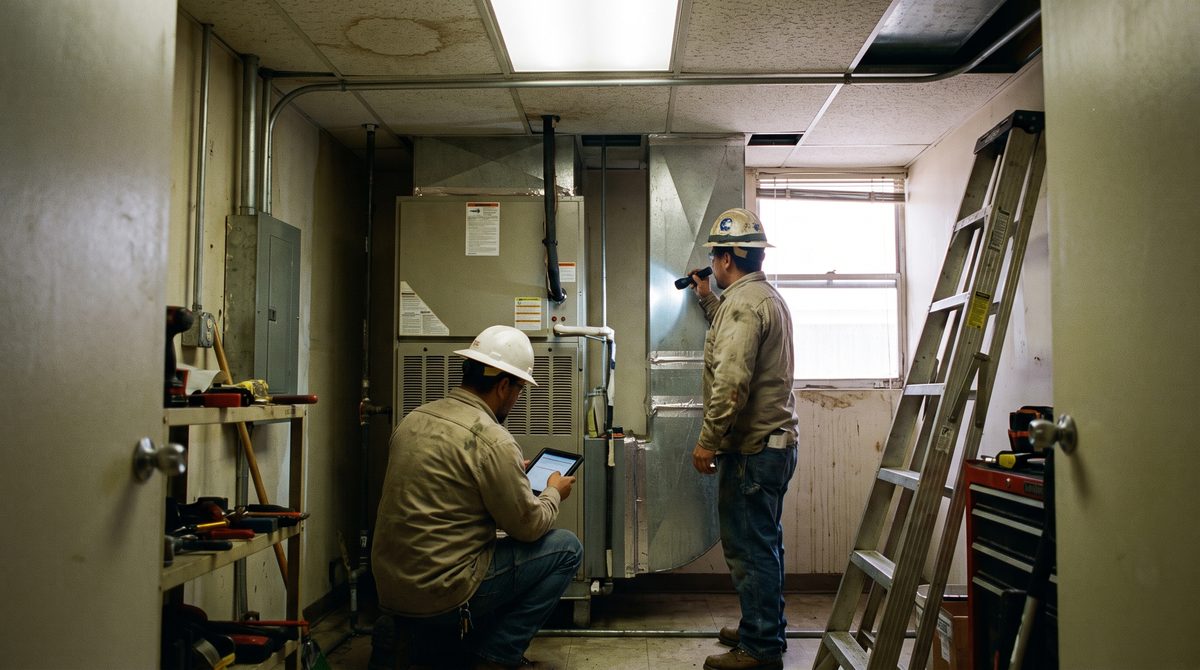
What an inspection checks first in Hollywood
First stops in a Hollywood building
- The plumbing chase serving the reporting unit, and every unit above and below on that stack
- Shared wall cavities, metered from both sides where access allows
- Bathroom extraction, which in original construction frequently does not exist
- The courtyard itself: drainage, planting and where water sits after rain
- Roof and parapet where the top floor is involved
Why in-place treatment changes the economics
In occupied stabilized housing, the cost of a demolition scope is not only the demolition. It is relocation, lost rent, and a timeline measured in weeks per unit.
Treating an area under containment while it is unoccupied and releasing it the same day removes most of that, which is usually the deciding factor rather than the remediation line itself.
Neighborhoods this comes up in most: Franklin Village, Beachwood Canyon, Melrose Hill. The method does not change by address; what the inspector expects to find does.
Follow the stack, not the complaint.
The first call comes from whoever noticed, and in a building with stacked bathrooms that is a matter of who is downstream. Scoping around that unit produces a treated apartment, a satisfied resident and an untouched source two floors up. Every building like this deserves a scope that starts at the plumbing chase and works outward.
Mold removal questions Hollywood owners ask
You can start it, and the written findings often matter more than the treatment at that stage. The inspection itself needs the owner’s authorisation, which is a question on the form. Where an owner is unresponsive, documented findings are usually what changes the conversation.
Only the ones that are actually affected, which is what the inspection establishes. The point of scoping the stack is to find out, rather than to treat everything or to treat only the unit that called. Both of those are guesses in opposite directions.
Very rarely. Areas are treated one at a time while unoccupied and most are back in use the same day. That is the practical reason this method fits occupied buildings, and in stabilized housing it is often the difference between a job that happens and one that does not.
For original 1920s construction, entirely. Many of these bathrooms were built with an operable window as the only extraction and the window has since been painted shut or the room reconfigured. Adding real extraction is frequently the source correction rather than anything more dramatic.
Book a free inspection in Hollywood
Say whether you are a resident, an owner or a manager, and how many units have reported anything.
What happens next
An inspector walks the property, most often Noel or Eddie, the two inspectors our customers name in review after review.
Written findings with the moisture source named, and no obligation attached to them.