
Mold Removal/Silver Lake, CA
Nobody has been
under there.
Stepped hillside foundations divide the underside into compartments, and most of them have not been entered since the house was built.
A free mold inspection on a hillside house
Silver Lake crawlspaces are stepped, cramped and awkward to reach, which is exactly why they go unexamined for decades. The inspection is the visit that finally opens one.
Why Silver Lake houses grow mold
Silver Lake is built across slopes, and its houses are built accordingly: post and pier foundations, stepped footings, cantilevered decks, and mid-century designs that reach out over the hillside rather than sitting on it. What that produces underneath is not a crawlspace so much as a series of awkward compartments at different heights.
Access is the defining problem. A hatch at one end reaches one section; the rest is behind a stepped foundation wall, under a deck, or beyond a run of ducting that fills the clearance. Practically, that means large parts of the underside of these houses have not been inspected since they were built, and the parts that are hardest to reach are usually the low points where moisture collects.
The moisture itself comes from ordinary sources made worse by geometry. Downspouts discharging onto a slope above the house, irrigation on a terraced garden, a deck that sheds onto the ground rather than away from it, and the same bathroom-fan-into-the-attic retrofit as everywhere else. The difference here is that when it goes wrong, nobody can easily get to where it went wrong.
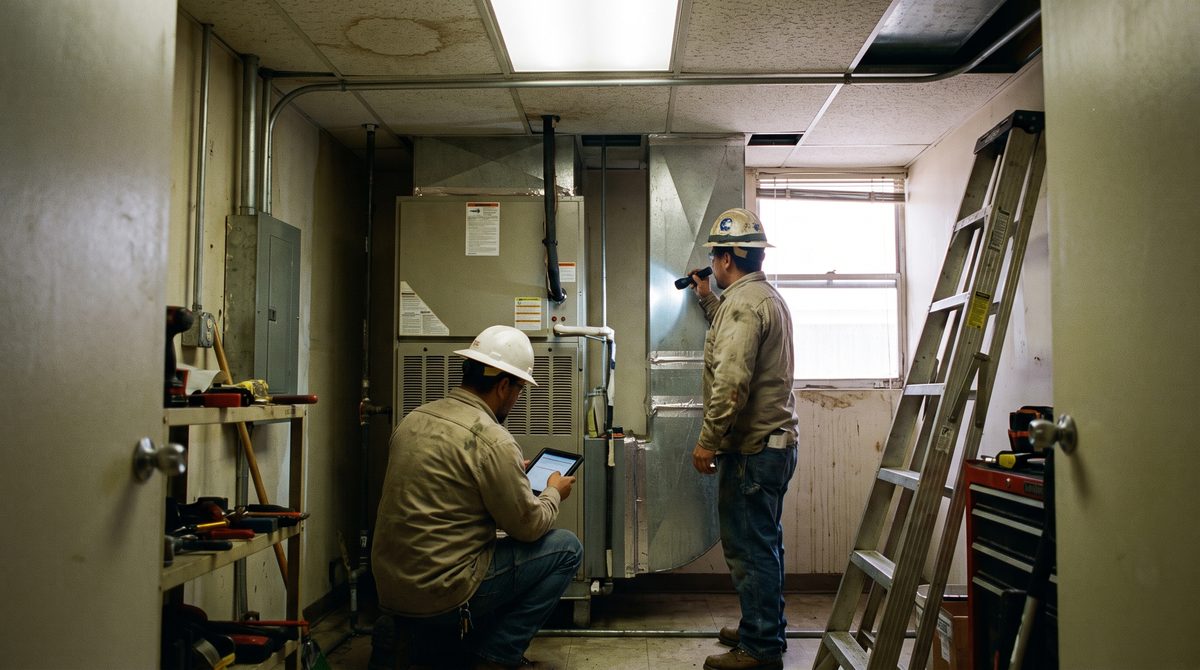
What an inspection checks first in Silver Lake
First stops on a Silver Lake property
- Every separate crawlspace compartment, not only the one the hatch opens onto
- The low point of the underside, which is where moisture collects and access is worst
- Deck framing and the ground beneath it, which sheds water toward the structure surprisingly often
- Downspout and terrace drainage above the house on the uphill side
- Duct runs lying on soil in the crawlspace, sweating and spreading whatever is around them
Access is the reason, not the obstacle
A method that requires reaching every surface by hand cannot service this housing stock honestly, and the industry’s usual answer is to treat what is reachable and describe it as the job.
A fog fills a compartment whether or not a person fits into it. That is why this is the construction type where the difference between the two approaches is largest.
Neighborhoods this comes up in most: Moreno Highlands, Ivanhoe, Sunset Junction. The method does not change by address; what the inspector expects to find does.
Treated what we could reach is not a finished job.
On a stepped hillside foundation, the difference between what a crew can physically touch and what actually needs treating can be most of the underside of the house. Ask any remediator how they intend to handle the compartments they cannot enter, and whether the clearance sampling will cover those areas or only the ones they worked in.
Mold removal questions Silver Lake owners ask
It is extremely common here and it is not an obstacle to booking. Finding and assessing the access is part of the inspection, and on a stepped foundation there is frequently more than one entry point, some of which the current owner has never been shown.
The fog fills the volume it is introduced into, so a compartment that connects to the treated space gets treated. A genuinely sealed section that shares no air path is a different matter, and it gets named in the findings rather than quietly included.
Often, yes. Deck framing sits in the weather and the ground under a deck is shaded, slow to dry, and frequently graded to shed toward the house rather than away. It is worth checking even when the complaint is coming from inside.
It covers the areas that were treated, and the report says which those were. That specificity is the point: a clearance that does not name the areas it sampled is not telling you much, and it is worth reading with that in mind whoever does the work.
Book a free inspection in Silver Lake
Silver Lake is about twenty five minutes out. Tell us what you know about crawlspace access, including that you do not know.
What happens next
An inspector walks the property, most often Noel or Eddie, the two inspectors our customers name in review after review.
Written findings with the moisture source named, and no obligation attached to them.