
Crawl Space Mold Removal/Los Angeles County
The smell starts
under the floor.
A musty house with nothing visible anywhere is usually a crawlspace telling you about itself. Air moves upward through a floor, and so does everything in it.
Have the crawlspace opened and read
Most people have never been under their own house, and most crawlspaces in this county have not been entered in years. The inspection is free and it is the fastest way to explain a musty room.
Why a crawl space you never enter changes the air you breathe
Warm air rises and leaves a house at the top, and something has to replace it. In a raised-foundation house a meaningful share of that replacement air is pulled up through the floor from the crawlspace, through gaps at plumbing penetrations, along the perimeter, and through the subfloor itself. Whatever is growing down there is upwind of every room above it.
That is why the classic symptom is a smell with no visible cause. People look at ceilings, behind furniture and inside cupboards, and find nothing, because the source is under the floor they are standing on.
Los Angeles crawlspaces have a specific problem: most of them are bare earth. Soil gives up moisture continuously, and in the foothill communities the subsurface flow off the mountains does not follow the rain calendar at all, so a crawlspace can be actively damp in September. Without a vapor barrier between that soil and the joists, the floor structure is sitting over a slow permanent humidifier.
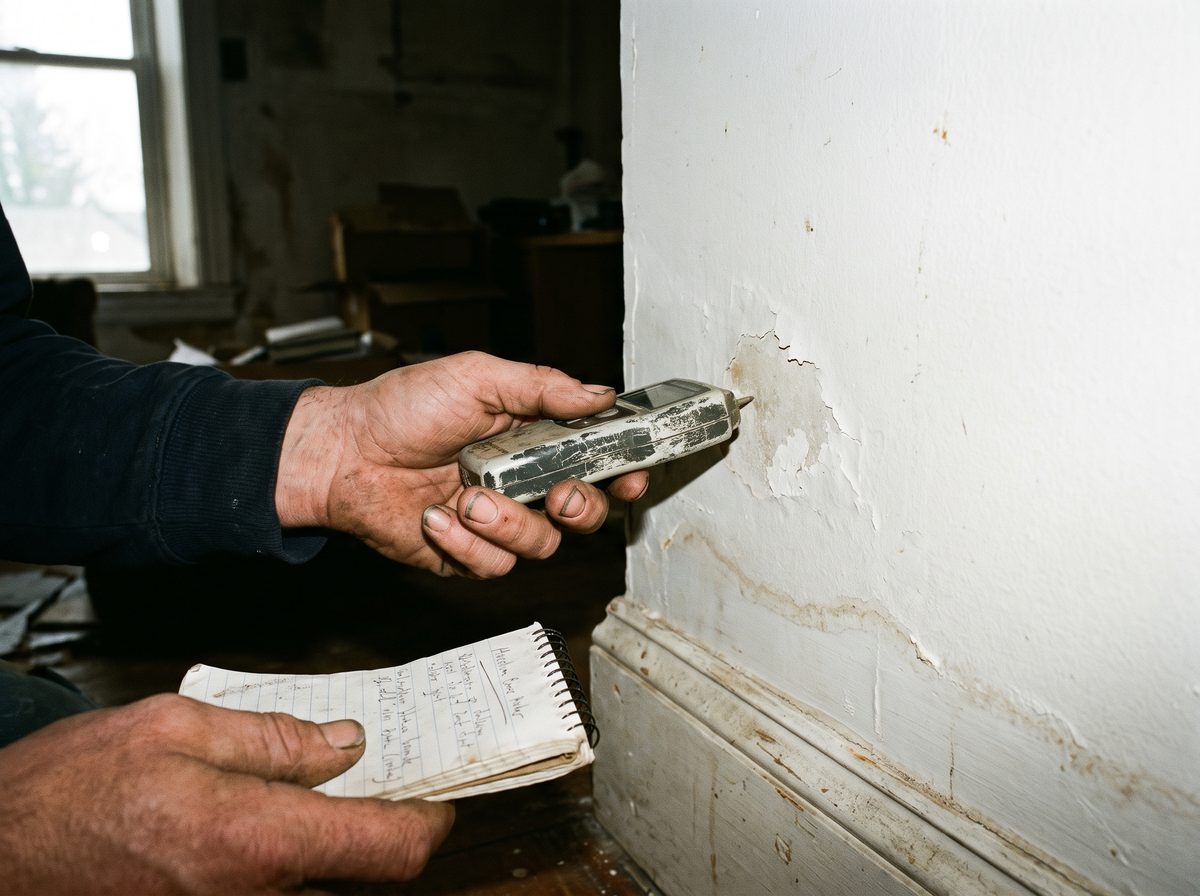
What an inspection finds under a Los Angeles house
Usually more than one of these at once, which is why a crawlspace scope names the source before it names a method.
The commonest finding by a distance, and the cheapest to correct.
Under a kitchen or a bathroom, dripping onto soil where nobody ever sees it.
Decades of landscaping that sends winter runoff into the crawlspace instead of away.
Planting, hardscape or an addition that sealed the cross-ventilation the house was designed with.
An HVAC drain quietly emptying into the crawlspace all summer.
Flex duct lying in the dirt, sweating, and distributing whatever is around it.
Treating a crawl space without pulling up the floor
The access problem, solved by physics
Crawlspaces are the hardest place in a house to clean by hand. Clearances drop to inches, ducts and plumbing block the path, and hillside houses on post and pier have corners nobody has ever physically reached.
A fog does not need to reach a surface with a hand. It fills the volume, so the far corner of a hillside crawlspace gets the same treatment as the patch by the hatch.
How a crawlspace job runs
- Source moisture identified first and named in the written findings
- Debris and any contaminated stored material removed, then HEPA vacuum on the accessible framing
- Sterilant fog through the full volume, reaching subfloor, joists, piers and the perimeter
- Second vacuum, then the protective fog on treated surfaces
- Air samples to an independent laboratory, read against an outdoor control
- Correction of the source: vapor barrier, drainage or the relevant trade, named explicitly
Nothing visible is not nothing.
A musty house where every wall looks clean is the most under-investigated situation in this trade, because there is no photograph to react to. The nose is usually right well before the eyes are, and the place to look is the one part of the house nobody has been in.
Crawl space mold questions
It is not sealed off from the house, which is the part people underestimate. Air moves from the crawlspace into the rooms above it continuously, so growth down there is in the air upstairs. Beyond air quality, sustained moisture against floor framing is a structural question eventually, not only a mold one.
Because rain is not the only water source. Bare soil releases moisture year round, a slow plumbing leak has no season at all, and in the foothill communities subsurface flow off the San Gabriels keeps ground damp through a dry summer. A crawlspace with no vapor barrier stays humid regardless of the forecast.
If the crawlspace is bare earth, yes, and treatment without it is the clearest example of what this company means by correcting the source. Killing the growth on the joists while the soil underneath keeps evaporating is a treatment with an expiry date.
It is exactly the case the method suits. Low clearance and hillside post-and-pier construction make hand cleaning impractical or impossible in parts, and a fog fills the volume instead. Access still matters for the inspection and for setting up, and genuinely sealed sections get flagged rather than quietly skipped.
When the crawlspace is the source, yes, and that is usually apparent within a day or two. If the smell persists after a clean clearance result, the source was somewhere else, and the written findings should already have told you whether the inspection found a second one.
Book a free crawl space inspection
Somebody opens the hatch, goes under, reads the moisture and comes back with the reason.
What happens next
An inspector enters the crawlspace, checks soil, vapor barrier, plumbing and ducting, and meters the framing.
Written findings naming the source, with no obligation attached to them.