Mold Removal/West Hollywood, CA
It usually comes
from upstairs.
In dense stacked multifamily the water in your ceiling is usually somebody else’s plumbing. The findings establish whose, in writing.
A free mold inspection in West Hollywood
In dense small-lot multifamily the water in your wall is most often somebody else’s. The inspection establishes whose, in writing.
Why West Hollywood houses grow mold
West Hollywood is one of the densest residential cities in the county, and its housing is overwhelmingly small-lot apartment buildings and condominiums, much of it pre-1960. Units are stacked, walls are shared, plumbing runs vertically through chases serving several apartments, and a great deal of the stock is rent-stabilized.
In that arrangement the single most common source of water in a wall is the unit above. A failed supply line, a shower pan that has lost its seal, a slow toilet leak at the flange: any of those puts water into the floor structure, and the floor structure is somebody else’s ceiling. It runs for a while before anyone downstairs notices a smell or a stain.
The consequence is that a scope drawn around one apartment is almost always drawn too small. Establishing which units are involved requires access to more than the one that complained, and that is a coordination problem as much as a technical one. It is also why the documentation matters: without it, a reasonable disagreement about responsibility has nothing to resolve itself against.
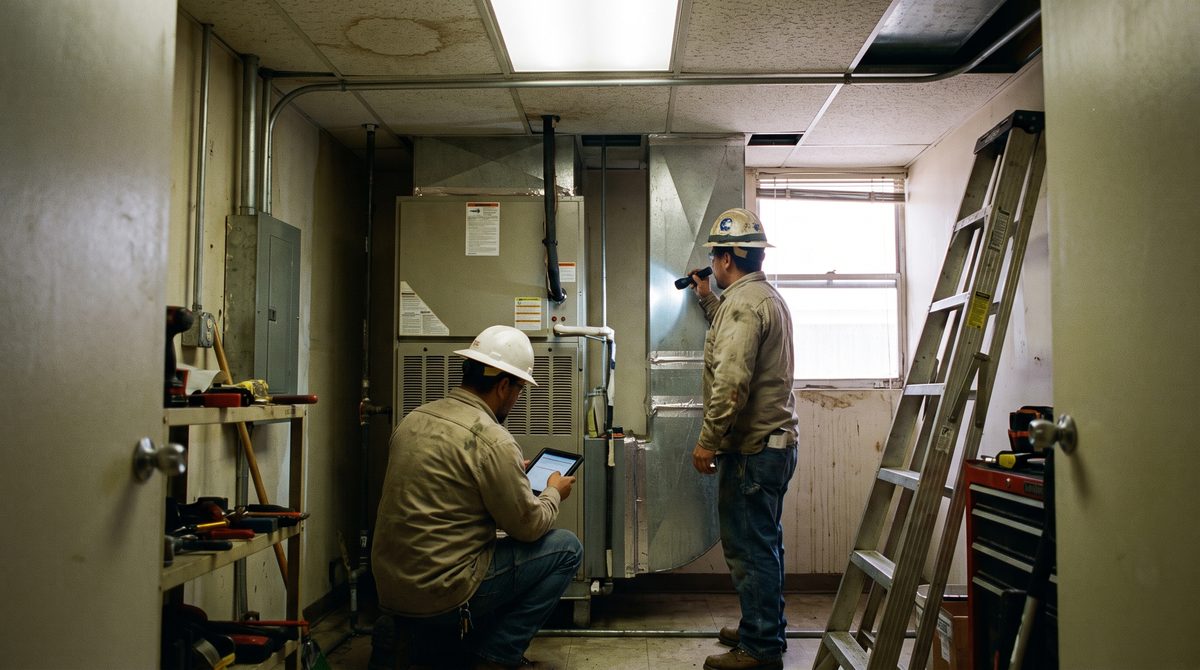
What an inspection checks first in West Hollywood
First stops in a West Hollywood building
- The unit above the reported area, and its bathroom and kitchen plumbing specifically
- The shared floor and ceiling assembly between the two, metered from below
- The vertical chase serving both, and any other unit on the same stack
- Bathroom extraction in each affected unit, which frequently vents into the structure
- Common areas and any shared HVAC connecting the units
Documentation is the deliverable
In stabilized multifamily, the question after the work is usually who pays, and that is answered by evidence rather than by argument.
Moisture readings, photographs, a written scope per area, and independent laboratory clearance naming the areas it covers. That set is what an insurer, an owner and a resident can all read the same way.
Neighborhoods this comes up in most: Norma Triangle, West Hollywood East, Sunset Strip. The method does not change by address; what the inspector expects to find does.
Water damage drying in West Hollywood
A leak from upstairs wets three things at once: the subfloor of the unit above, the cavity between the floors, and the ceiling drywall below. Drying the ceiling and calling it done leaves the cavity wet, and the cavity is where mold starts. The drying plan covers the whole assembly, not one apartment.
That takes access to both units, readings in both, and equipment set where the water actually sits, which is sometimes an upstairs closet rather than the stained ceiling. It runs until the readings say dry, usually days rather than hours, and the findings record each reading with its date.
Ceiling drywall that has sagged or stayed soaked usually has to come down. A ceiling that took a short leak and dried fast often does not. That call is made with a meter, in writing.
One record for everyone
After one leak the owner, the association, the resident and more than one insurer can all be involved.
A single set of readings, photographs and a dry date settles more of that than any number of phone calls. How the drying works, and when it turns into a mold job, is on the water damage drying page.
Two units, one wall cavity.
The wall between two apartments is not two walls. It is one cavity that both sides share, and treating one face of it while the other side stays wet is a job that will be back. Getting access to both sides is frequently the hardest part of a West Hollywood inspection and it is the part that decides whether the result holds.
Mold removal questions West Hollywood owners ask
Practically, the owner or the association, guided by the governing documents and by where the water originated. Our part is establishing that in writing. A scope and moisture readings that identify the source unit are what turn a dispute into a decision.
We can inspect what you can authorise, and the findings will say clearly what could not be reached. That limitation is worth having in writing, because a report that names the missing access is far more useful than one that quietly works around it.
Almost certainly not. The treated area is unoccupied while it runs, usually for a matter of hours, and most residents are back the same day. That is a meaningful difference in stabilized housing where relocation is complicated for everyone involved.
Until the readings say dry. For a contained leak caught early that is usually a few days. A leak that ran for weeks, or soaked the cavity between floors, takes longer. The equipment is loud and needs power, so plan for it if you work from home.
Not the drying. West Hollywood’s Rent Stabilization Ordinance applies in full to multifamily rental units built before July 1, 1979, which is much of the older stock where one plumbing stack serves several apartments. What it changes is how much the paperwork matters: a dated record of the source, the readings and the dry date is something the owner, the tenant and the city can all read the same way.
It is a real one and it is common in this stock. A fan discharging into a floor or ceiling assembly rather than outside puts warm humid air directly into the structure several times a day, which is a source in its own right independent of any leak.
Book a free inspection in West Hollywood
Say whether you are a resident, an owner or a manager, and whether you have access to the unit above.
What happens next
An inspector walks the property, most often Noel or Eddie, the two inspectors our customers name in review after review.
Written findings with the moisture source named, and no obligation attached to them.