
Mold Removal/Los Angeles County
Five steps.
Always in this order.
Two of the five steps are fogs and they do different jobs: one kills what is growing, one protects what is left. The order is fixed, and every step exists because the step before it left something behind.
Find out what your house actually needs
The sequence only makes sense once somebody has found the water. The on-site inspection is free and it is what tells you whether this is a treatment job, a plumbing job, or nothing at all.
What the treatment actually is
Mold is not a stain. It is a colony living on and inside building material, fed by water that arrived from somewhere, and anything that kills what is visible while leaving the rest is a delay rather than a repair. That is why the sequence below has five steps and why the first one is not the fog.
Mold Zero calls it the unique signature 5 step fogging process, and the fog is the part almost nobody else in this trade does. A liquid is atomised into a particle small enough to behave like a gas, so it moves the way air moves and reaches into the wall cavity, the attic, the crawlspace and the underside of the subfloor rather than sitting on the first surface it meets. In most cases the plaster does not even have to come off for that to happen.
The technology did not come from the trades. The founder’s wife, a registered nurse, found it in medical environments where surfaces have to be treated without being dismantled, and almost nobody was applying it inside houses. Paired with source removal, HEPA cleaning and moisture correction, it became the system this company runs.
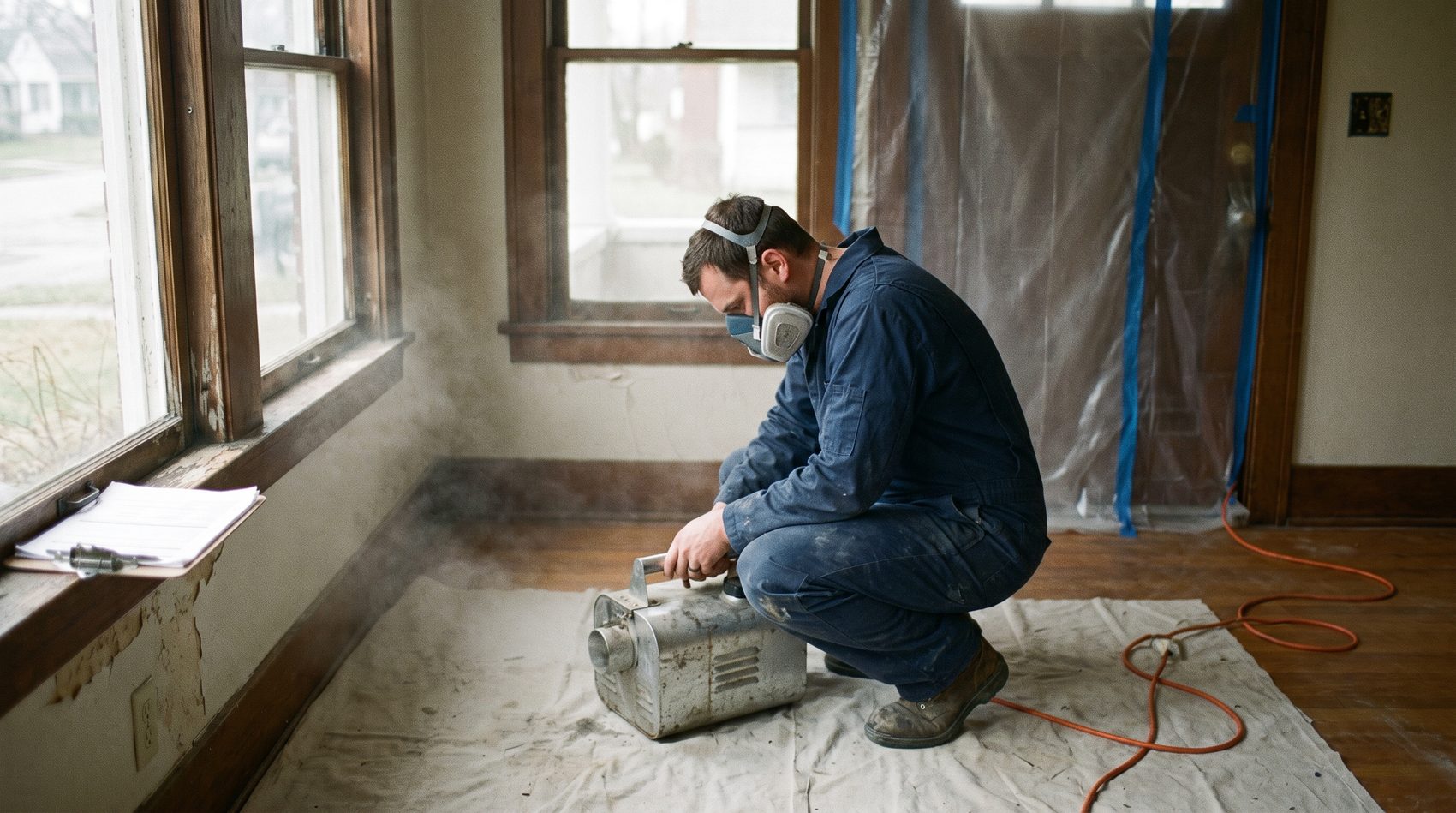
The signature five step fogging process, in order
The order is not decoration. Fogging a surface that still carries loose spores and household film treats the film, not the surface.
HEPA vacuum
Loose spores, dust and debris come off every accessible surface first. Anything that can be physically removed is removed, because treating a layer of dust only treats the dust.
Hygienic damp wipe
Surfaces are wiped so the fog meets the material rather than the residue on top of it. This is the unglamorous step, and skipping it is the most common reason a fogging job underperforms.
Spor-Klenz fog
Spor-Klenz is a sterilant and disinfectant that kills bacteria, viruses, fungi and tough bacterial spores. Fogged, it fills the contained space and moves into wall cavities, attics and crawlspaces, which is how it reaches growth nobody can see.
Second HEPA vacuum
Dead spores are still spores. The second vacuum removes the remains, because a dead colony left where it is is still allergenic material sitting in your air.
Goldshield fog
Goldshield is fogged over the treated surfaces and leaves an antifungal layer protecting against future mold growth. This is the step the one year guarantee is written against, and the reason the mold does not come back.
Between steps three and five the property is unoccupied and under containment. The treatment is non-toxic: we often fog in the afternoon and the household is home for dinner that night.
What the treatment does not do
Still has to come out
- Material that is saturated rather than contaminated. Wet drywall is a sponge, not a surface
- Wood with structural rot. Killing the fungus does not give the joist its strength back
- Anything sitting in standing water, or a cavity with an active leak still running into it
- Insulation that has absorbed enough moisture to have stopped being insulation
Roughly a third to a half of our jobs involve removing some material. You hear which one you are at the inspection, not after the invoice.
And the one it cannot fix at all
The fog treats what is growing. It does not treat the reason it grew.
A bath fan venting into an attic, a crawlspace with bare soil, a slab leak, a roof flashing that has been failing for two winters: every one of those keeps producing water after the best treatment anyone can run.
That is why the process starts at the inspection and not at the fogger. What is not corrected at the source always comes back.
Home in time for dinner.
The treatment is non-toxic, which is the whole reason the day works the way it does. The crew fogs in the afternoon under containment with nobody in the house, the containment comes down, and the family comes back that night. That was the original requirement, because the first house treated this way was the founder’s own.
Mold removal questions people ask first
Yes. The treatment is non-toxic, applied under containment while the space is unoccupied. Once it is finished and the space is cleared you move back in, and in practice that is the same evening. Most households are back in the same day.
Because the particle is small enough to move like a gas rather than fall like a spray. Wall cavities, attics and crawlspaces are connected to the air in the room by more paths than most people expect: outlet boxes, plumbing and wiring penetrations, gaps at the top plate. The fog follows those paths.
Most treatments run a few hours and most properties are back in use the same day. Larger buildings, and jobs where material has to be removed or the structure has to be dried first, take longer. You get a real timeline at the inspection, based on what was measured rather than a generic range.
Post-treatment air samples go to an independent laboratory and the report goes to the property owner. If the numbers are not clean, we come back. A one year written guarantee covers regrowth on treated surfaces absent a new water intrusion.
Yes, and the same-day turnaround is the reason it suits multifamily work. Areas are treated one at a time under containment while unoccupied, then released. Commercial and HOA jobs are scoped per building so a board can see which areas were treated and when.
Book a free inspection
The process starts with finding the water, not with the fogger. That visit is free and it ends in written findings either way.
What happens next
An inspector walks the property, most often Noel or Eddie, the two inspectors our customers name in review after review.
You get a scope built around what the property actually needs. Where material has to come out, the findings say so.